What Happens When a Browser Requests a PHP Page
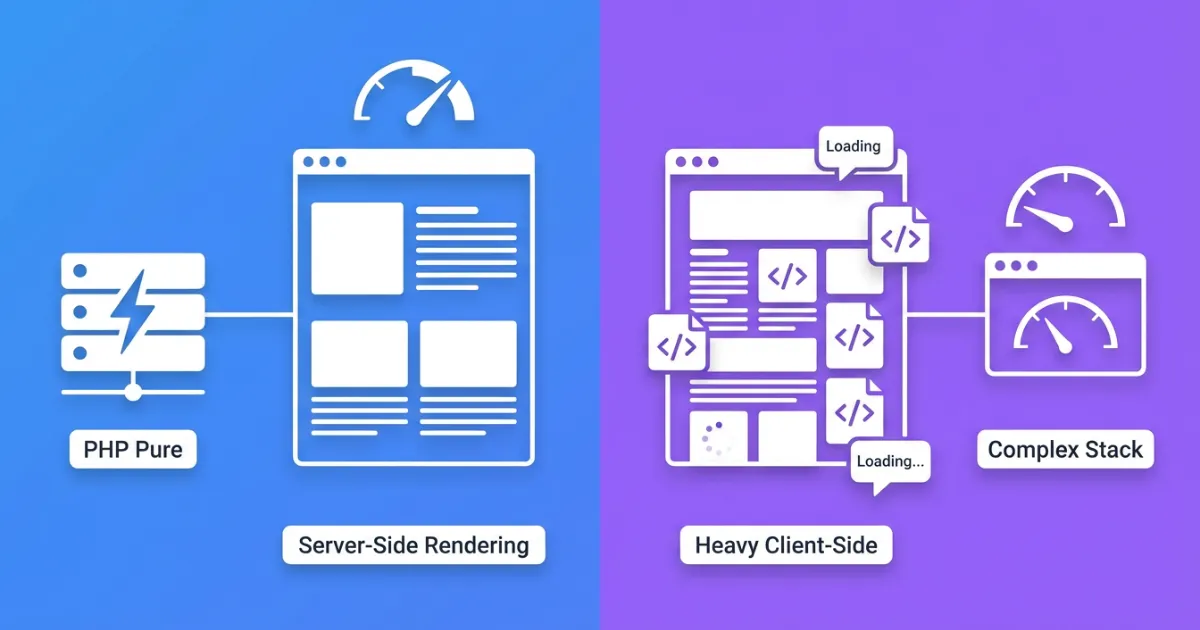
A user types a URL. The server receives the request, executes a PHP script, and sends back a fully rendered HTML document. The browser parses that HTML and begins painting pixels on screen. No JavaScript bundle to download. No hydration step. No second round trip to fetch data from an API. The page simply loads.
This sequence of events, mundane as it sounds, explains why pure PHP websites consistently outperform JavaScript framework builds on Core Web Vitals. And in a search landscape where Google uses page speed as a ranking signal, that performance gap translates directly into visibility.
Server Side Rendering vs. Client Side Rendering: A Speed Comparison
When a React or Vue application loads in the browser, the initial HTML document is often a near empty shell. The browser must download a JavaScript bundle (frequently exceeding 200KB gzipped), parse it, execute it, fetch data from one or more API endpoints, and then render the interface. Each of these steps adds latency.
PHP takes a different path. The server processes logic, queries the database if needed, and delivers complete HTML. The browser receives a document ready to display. There is no blank screen while scripts load. There is no layout shift as components mount asynchronously.
The difference is measurable. Run a Lighthouse audit on a typical React single page application and compare it against a well structured PHP site serving equivalent content. The PHP site will almost always score higher on First Contentful Paint and Largest Contentful Paint, two metrics that directly influence how Google evaluates page experience.
This is not a theoretical exercise. Builders like Lovable and Bolt generate React SPAs that require client side rendering. The HTML they ship to Google's crawler contains minimal content. For businesses that depend on organic search traffic, this architectural choice has real consequences.
Why PHP Delivers Faster Time to First Byte
Time to First Byte (TTFB) measures how long it takes for the server to begin sending a response after receiving a request. PHP excels here because the execution model is straightforward: the web server hands the request to the PHP interpreter, which processes the script and returns output.
Modern PHP (versions 8.x) includes a JIT compiler and OPcache, which stores precompiled script bytecode in shared memory. On subsequent requests, PHP skips the parsing and compilation stages entirely. For a typical brochure site or blog, this means TTFB values well under 200 milliseconds on modest hosting.
Framework based stacks introduce additional overhead. A Node.js server running a React SSR application must boot the JavaScript runtime, resolve module dependencies, and execute rendering logic that was originally designed for browser environments. Even with caching layers, the baseline cost is higher.
For web speed, PHP vs frameworks is not really a contest when we isolate TTFB. The simpler execution model wins.
HTML Weight and Transfer Size
A PHP page serving semantic HTML with Tailwind CSS utility classes produces a remarkably lean document. A full landing page might weigh 30 to 50KB including inline critical CSS. The browser needs a single HTTP request to get everything it needs for the initial render.
Compare this to a framework build. A basic Next.js page ships with:
- The HTML shell
- A runtime JavaScript chunk
- Framework specific chunks (React, ReactDOM)
- Page specific JavaScript
- CSS modules or styled components
- JSON data for hydration
Even after code splitting and tree shaking, the total transfer size for a simple page routinely exceeds 150KB. Each additional kilobyte adds parsing time, especially on mobile devices with constrained CPU budgets.
The weight difference compounds across a multi page site. A visitor navigating five pages on a PHP site downloads roughly the same amount of data per page. On a framework SPA, the initial load is heavy, and subsequent navigations may be fast, but only if the user actually stays on the site long enough to benefit from client side routing. Most visitors from search engines land on one page and either convert or leave.
Core Web Vitals and the SEO Connection
Google's Core Web Vitals assessment includes three metrics: Largest Contentful Paint (LCP), Cumulative Layout Shift (CLS), and Interaction to Next Paint (INP). PHP sites have structural advantages on all three.
LCP benefits from server rendered content arriving in the first response. The largest element on the page, typically a hero image or heading, is present in the HTML from the start. No JavaScript needs to execute before it becomes visible.
CLS stays low because the page layout is defined in the initial HTML. Framework applications that load data asynchronously and inject content after the initial render frequently cause layout shifts as elements resize or reposition.
INP improves when there is less JavaScript competing for the main thread. A PHP page with minimal JavaScript allows the browser to respond to user interactions, clicks, scrolls, form inputs, without waiting for script execution to complete.
These are not marginal differences. For businesses in competitive search verticals, passing Core Web Vitals thresholds can mean the difference between page one and page two of search results. Tools like SpeakSite's automatic SEO system generate PHP output specifically optimized for these metrics, including semantic HTML5 elements, schema.org markup, and properly structured heading hierarchies.
The Semantic HTML Advantage
PHP encourages a direct relationship between server logic and HTML output. When a developer, or an AI builder, writes a PHP template, the output is literal HTML. This makes it natural to produce semantic markup: header, nav, main, article, section, footer.
JavaScript frameworks abstract HTML behind component trees. The resulting DOM often consists of deeply nested div elements with generated class names that carry no semantic meaning. Screen readers struggle with this structure. Search engine crawlers extract less meaningful information from it.
Semantic HTML matters for web speed because browsers can begin rendering meaningful content earlier when they understand the document structure. A main element tells the browser where the primary content lives. A properly ordered heading hierarchy (H1 through H6) allows both browsers and search engines to parse the page's information architecture without executing JavaScript.
This is why platforms focused on SEO performance choose PHP as their output format. The language's template model produces clean, crawlable, accessible HTML by default rather than as an afterthought.
Caching: Where PHP Gets Even Faster
PHP pages can be cached at multiple levels with minimal configuration. A simple file based cache can store the rendered HTML output of a page, reducing subsequent requests to a static file serve. OPcache handles bytecode caching at the interpreter level. Reverse proxies like Varnish or even basic Apache mod_cache can serve PHP generated pages without touching the PHP interpreter at all.
This layered caching architecture means that a PHP site under load performs closer to a static file server than a dynamic application. During traffic spikes, whether from a successful ad campaign or a viral social media post, cached PHP pages continue to serve in single digit milliseconds.
Framework applications can achieve similar cache performance, but the configuration is more involved. SSR caching with React or Vue requires careful invalidation strategies, edge function configuration, and often a paid CDN tier. The operational complexity is substantially higher for an equivalent result.
When Frameworks Make Sense (and When They Do Not)
PHP is not the right choice for every project. Applications with rich client side interactivity, real time collaborative features, or complex state management benefit from JavaScript frameworks. A spreadsheet application, a chat interface, or a drag and drop dashboard would be poorly served by server rendered PHP.
But most business websites are not applications. They are content delivery vehicles: landing pages, service descriptions, blog posts, contact forms, portfolios. For these use cases, a framework adds architectural complexity without a corresponding benefit.
Consider the typical small business site: five to fifteen pages, a contact form, perhaps a blog. Built with PHP and Tailwind CSS, this site loads in under one second on a mobile connection, scores above 90 on all Lighthouse categories, and costs under ten dollars a month to host on shared infrastructure. The same site built with Next.js requires a Node.js hosting environment, produces larger page weights, and demands ongoing maintenance of npm dependencies.
The choice should be driven by the project's actual requirements, not by industry trends. For content focused websites where organic search traffic matters, PHP based builders deliver measurably better outcomes.
Making the Speed Advantage Work for Your Business
Raw page speed means nothing if the content is thin or the user experience is poor. But when content quality is equal, faster pages win. They rank higher. They convert better. They cost less to serve.
If you are building a business website, a professional portfolio, or a content marketing hub, start with the architecture that gives you an inherent speed advantage. Choose tools that output semantic PHP and clean HTML rather than JavaScript bundles that need to bootstrap in the browser. Verify your Core Web Vitals scores with real field data, not just lab tests. And prioritize hosting environments optimized for PHP execution.
The web speed debate between PHP and frameworks often gets framed as old technology versus new. That framing misses the point. PHP is not fast because it is old. It is fast because its execution model, delivering complete HTML from the server, aligns with how browsers and search engines actually consume web pages. That alignment is not a legacy advantage. It is an architectural one.
Ready to build a website that loads fast and ranks well? Try SpeakSite and see the difference clean PHP output makes for your search visibility.